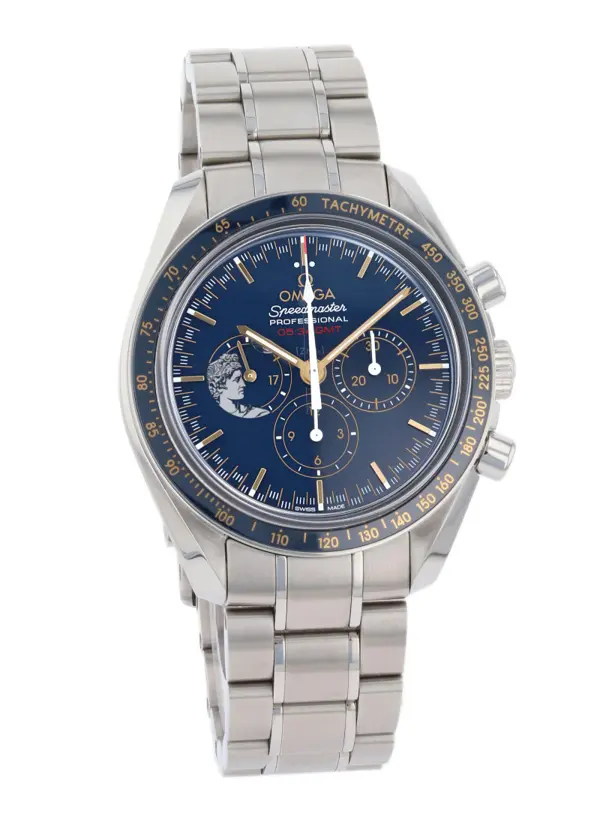
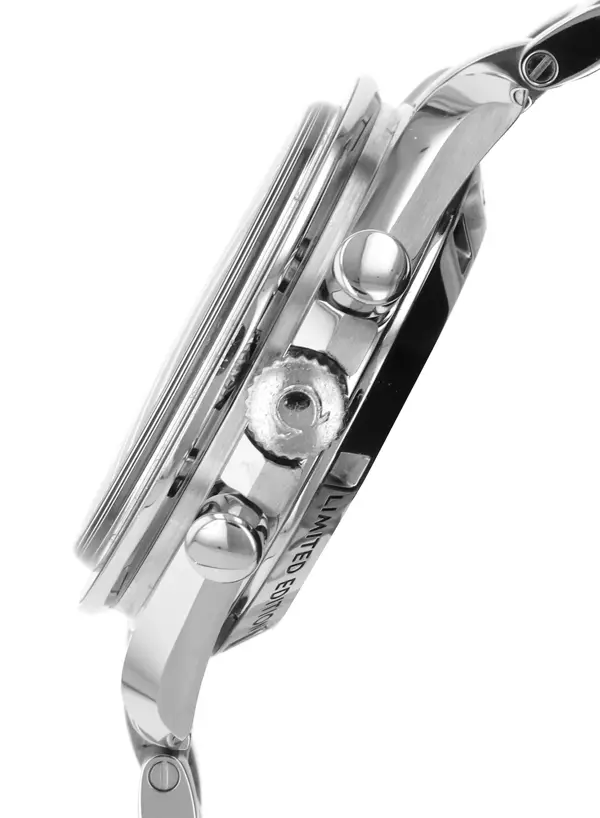
The Omega Speedmaster is one of the few watches with a real claim to history: it was qualified by NASA for spaceflight and worn on the Moon. It is also a family of many models, with several movements, crystals and sizes, which can make buying one confusing.
This Omega Speedmaster buying guide explains the Moonwatch and its generations, the differences that matter (movement, crystal, case back), the other Speedmaster lines, and what to check before you buy.
A short history
Omega introduced the Speedmaster in 1957 as a sports and racing chronograph, with the tachymeter scale on the bezel rather than on the dial.
In 1965, after a series of tests, NASA qualified the Speedmaster for its crewed missions. In 1969 it was on the wrist of the astronauts of Apollo 11 when they walked on the Moon. From then on, the manual-wind Speedmaster Professional became known as the Moonwatch, and it is still in production today.
The Moonwatch generations
The Moonwatch has kept the same basic look for decades, but its movement has changed. The movement is the most useful way to tell generations apart.
| Calibre | Era | What to know |
|---|---|---|
| 321 | The original, from the 1950s and 1960s; re-introduced in 2019 | Column-wheel chronograph; the movement of the early Moonwatches |
| 861 | From the late 1960s | Simpler cam-lever chronograph; the Moonwatch workhorse for decades |
| 1861 | From the late 1990s | An updated version of the 861 |
| 3861 | Current (since 2021) | Co-Axial escapement and Master Chronometer certification |
All of these are manual-wind: you wind the watch by the crown, ideally every day, at the same time. Many owners enjoy this ritual; if you would rather not wind a watch, look at the automatic Speedmaster models below.
The current Moonwatch Professional
The current Moonwatch Professional uses the calibre 3861, a manual-wind chronograph with Omega's Co-Axial escapement and Master Chronometer certification, tested by the Swiss federal metrology institute (METAS) for accuracy and resistance to magnetic fields. It has a 42 mm case, a power reserve of about 50 hours and water resistance of 50 m.
Hesalite or sapphire?
The Moonwatch Professional comes in two main versions:
| Hesalite | Sapphire ("sapphire sandwich") | |
|---|---|---|
| Front crystal | Hesalite (acrylic) | Sapphire |
| Case back | Solid, engraved | Sapphire display back, showing the movement |
| Look | Warmer, closer to the historic Moonwatch | Clearer, more modern |
| Scratches | Scratches more easily, but light scratches can be polished out | Very scratch-resistant |
Hesalite is the material used on the watches flown in space, because it does not shatter into sharp fragments. Many collectors choose it for that reason. Sapphire suits buyers who want a crystal that stays clear, and a view of the movement.
The other Speedmaster lines
Not every Speedmaster is a Moonwatch. The family also includes:
- Speedmaster '57: inspired by the original 1957 design, with a straight lug profile and a manual-wind co-axial movement. See our Speedmaster '57 watches.
- Speedmaster 38: a smaller, automatic chronograph at 38 mm, popular for smaller wrists.
- Speedmaster Racing: an automatic chronograph with a racing-inspired minute track.
- Speedmaster Dark Side of the Moon: larger ceramic automatic chronographs.
- Moonphase and special editions, including models with a moon-phase display and commemorative dials.
If you want the Speedmaster look without winding every day, choose one of the automatic lines.
What to check before you buy
- The reference and the calibre. They tell you the generation. A listing should state both, or you should ask.
- Crystal and case back: Hesalite with a solid back, or sapphire with a display back.
- The bracelet. Moonwatch bracelets changed over the years; check that it suits the reference.
- Box, papers and warranty. The warranty card shows when the manufacturer's warranty started. See why box and papers matter.
- The chronograph. On a watch in hand, start, stop and reset the chronograph. The hands should return precisely to zero.
- Condition of the Hesalite crystal. Light scratches are normal and can be polished; cracks are not.
For older models, service history matters. For the full buying checklist, read how to buy a luxury watch online safely.
Which Speedmaster is right for you?
| If you want… | Look at… | Why |
|---|---|---|
| The watch closest to the one worn on the Moon | Moonwatch Professional with Hesalite | Historic crystal and solid case back, current movement |
| To see the movement | Moonwatch Professional with sapphire | Display back and a scratch-resistant crystal |
| A smaller chronograph | Speedmaster 38 | 38 mm and automatic, easy to wear every day |
| No daily winding | Speedmaster 38 or Racing | Automatic movements |
| A vintage-inspired design | Speedmaster '57 | Straight lugs and a design inspired by the 1957 original |
| Something bolder | Dark Side of the Moon | Ceramic case and a more modern look |
If you are undecided, start with the Moonwatch Professional. It is the model the Speedmaster name is built on, and it holds a special place with collectors.
Living with a manual-wind chronograph
If you have never owned a manual-wind watch, the Moonwatch asks for a small daily habit.
- Wind it every day, ideally at the same time, for example in the morning. Turn the crown gently until you feel resistance, then stop. Do not force it.
- Use the chronograph freely. Starting, stopping and resetting the chronograph is what it is made for. On a watch in good condition, the hands should always return exactly to zero.
- Keep it away from strong magnets if you have an older model. The current Master Chronometer movement is highly resistant to magnetic fields, but older generations are not.
- Look after the Hesalite crystal. Light scratches on Hesalite can be polished out with a suitable acrylic polish. Deep scratches or cracks need a new crystal.
- Service it as recommended by Omega, or sooner if timekeeping or the chronograph functions change.
Bracelet or strap?
The Moonwatch is one of the easiest watches to change the look of.
- On the steel bracelet it is a robust, everyday sports watch.
- On a leather strap it looks more vintage and dressier.
- On a fabric or rubber strap it becomes lighter and more casual, closer to how it was worn in space programmes.
A few extra straps are an inexpensive way to get several watches out of one. Check the lug width of your exact reference before you buy straps.
How the Speedmaster compares
| Omega Speedmaster Moonwatch | Rolex Cosmograph Daytona | Breitling Navitimer | |
|---|---|---|---|
| Heritage | Space: qualified by NASA, worn on the Moon | Motor racing | Aviation |
| Winding | Manual | Automatic | Automatic (current models) |
| Signature feature | Tachymeter bezel, Hesalite option | Tachymeter bezel, strong demand | Slide-rule bezel |
| Character | Tool watch with history | Luxury sports icon | Pilot's instrument |
All three are classic chronographs. The right one depends on which story you connect with and whether you want to wind your watch.
Moonwatch or another chronograph?
If you are deciding between a Speedmaster and a Rolex Daytona, the difference is less about quality than character. The Speedmaster is manual-wind and rooted in space history; the Daytona is automatic and rooted in motor racing. Most people who love one also respect the other.
If you are new to movements, our guide to automatic vs quartz explains the basics, including manual winding.
Shop the Speedmaster
Browse the Speedmaster Moonwatch, all Speedmaster models, or the full Omega collection. Every listing shows the reference, condition, year and whether box and papers are included.
Frequently asked questions
Is the Omega Speedmaster Moonwatch automatic?
No. The Moonwatch Professional is manual-wind: you wind it by the crown. Other Speedmaster models, such as the Speedmaster 38 and the Racing, are automatic.
What is the difference between the 1861 and 3861 Moonwatch?
The 3861 is the current movement. It adds Omega's Co-Axial escapement and Master Chronometer certification, including high resistance to magnetic fields. The 1861 was the previous generation.
Hesalite or sapphire: which is better?
Neither is better in every way. Hesalite is the historic material and has a warmer look; sapphire is more scratch-resistant and comes with a display back.
How often should I wind a Speedmaster Moonwatch?
Once a day, ideally at the same time, until you feel resistance. Stop there; a manual-wind watch should not be forced.
Does the Speedmaster hold its value?
The Moonwatch is one of the most recognised watches in the world and has a large, steady following. Like any watch, its value depends on the market, the reference, the condition and whether box and papers are included, so buy the model you want to wear rather than as an investment.
How is a Speedmaster serviced?
Like any mechanical chronograph, it needs a full service from time to time, by Omega or a qualified watchmaker. The movement is taken apart, cleaned, lubricated and adjusted, and the chronograph is checked. Follow Omega's recommendation for your model, or service it sooner if timekeeping or the chronograph functions change.
Is the Speedmaster a good first luxury watch?
Yes, for many buyers. It has real history, a robust design and a wide range of models and prices. If you do not want to wind a watch, choose an automatic Speedmaster.